
Kansas Corrections Facility Map
The Kansas Department of Corrections is a statewide prison system. It is included among the facilities serving Washington County because the Washington County District Court can sentence a person to KDOC custody. The official facility map reviewed for this project shows no KDOC prison physically within Washington County. A person sentenced there may be assigned to an institution elsewhere in Kansas, moved between institutions, or placed under community supervision after leaving prison.
Geography cannot identify the right institution. Use the actual current housing or supervision entry in the state record. Washington County Jail may document the first transfer to KDOC, but it cannot certify a later prison release, parole placement, postrelease status, or final discharge. Those later events belong to KDOC and its statewide records.
Statewide adult correctional system
No KDOC prison located in Washington County
Public person search: KASPER
Sentence Computation Unit: 785-296-3317
Official KDOC resources
Search Kansas Corrections Records
KASPER’s disclaimer and search provide the correct starting point for an adult sentenced to the Secretary of Corrections. KASPER means Kansas Adult Supervised Population Electronic Repository. It is person-centered, not tied to one county prison. It can include people sentenced since 1980 who are incarcerated, under post-incarceration supervision, or discharged from a sentence.
- Accept the official notice and search by KDOC number when it is known. Otherwise use the available name and identity fields.
- Compare the KDOC number, aliases, age or birth information, physical details, and photograph before choosing a record.
- Read conviction county, case, sentence, current housing, movement, and supervision data together.
- Copy the exact status and date labels. Do not rewrite a supervision status as final discharge.
- Check the Washington County court journal entry when the sentence or jail credit needs confirmation.
The Washington County released-inmate search covers county, state, and transfer paths. KASPER is the proper branch only when KDOC took authority. A short county term, bond release, or municipal booking may never appear there.
Kansas Corrections Search Fields
The live KASPER form supports several ways to narrow a match. Name-only results deserve care because aliases and similar names can point to different people. A KDOC number is the strongest public repository key. The KBI state identifier may also help, while conviction county can connect a state record to Washington County.
| Search field | Use | Limit |
|---|---|---|
| Last, first, middle name | Starts a person search | Spelling and aliases can vary |
| KDOC number | Identifies the state correctional record | Must match the right person |
| KBI identifier | Narrows by Kansas state identifier | Not always known to the searcher |
| Birth date or age | Separates similar names | Confirm against more than one field |
| Conviction county | Connects the record to Washington County | One person may have cases in several counties |
| Supervision county | Helps locate community supervision | It may differ from conviction county |
KDOC’s official locating information says records can include crimes, case numbers, housing, movement dates, parole office, custody or supervision level, and institutional discipline. Field availability varies by person and record age. Photograph controls may reveal an official offender image, which is not necessarily the Washington County booking image.
Kansas Corrections Release Status
Leaving a prison building and ending state authority are separate events. A KASPER status should be quoted as shown. Parole or postrelease supervision generally means the person lives outside the institution under correctional rules. Conditional release can also carry continuing authority. Discharged is the more final term, but it must still be tied to the right sentence and case.
- Incarcerated
- The record places the person in KDOC institutional custody.
- Parole
- Community release under authority used for eligible sentences.
- Postrelease supervision
- A statutory community supervision term that follows prison for many guidelines sentences.
- Absconder
- The agency reports loss of contact or noncompliance; this does not itself prove a new conviction.
- Discharged
- KDOC sentence authority shown for the identified matter has ended.
A person can have more than one sentence or legal obligation. One displayed date may not resolve all of them. If KASPER shows an institution, disappearance from the Washington County jail did not mean community release. If it shows supervision, physical prison release occurred but final discharge may remain in the future.
Kansas Corrections Release Paths
A Washington County felony can begin with local detention, continue through sentencing, and then move into the statewide system. Transfer from the county jail to KDOC is not release to the community. KDOC intake, classification, housing, later movement, and prison exit form a separate custody timeline. The Washington County criminal case remains useful because its journal entry states the sentence, jail-time credit, and whether terms run together or one after another.
| State record result | Meaning | Next confirmation |
|---|---|---|
| Current institution | Still in state prison custody | Use the institution named in KASPER |
| Parole or postrelease | Outside prison with state supervision | Confirm through KDOC Parole Services |
| Conditional release | Outside the institution under the governing sentence rules | Read the state record and sentence together |
| Transferred or moved | Custody location changed | Follow the receiving institution or authority |
| Discharged | State sentence authority ended for the displayed matter | Record the exact date and match the court case |
A detainer can send someone from KDOC to another authority rather than home. Interstate supervision can place the person outside Kansas while KDOC-related authority continues. Always identify the destination and legal status instead of treating every prison departure as freedom.
Kansas Corrections Release Dates
KDOC identifies its public future-date field as “Anticipated release date.” The label matters. It is an estimate before the event, not proof that release happened. Good-time earnings or loss, program credit, sentence aggregation, jail credit, amended court orders, consecutive cases, and other legal authority can change a calculation. Capture the access date and return to the live record before relying on it.
K.S.A. 21-6821 sets different credit limits for covered offense groups and dates. Some qualifying sentences have a 15 percent good-time cap, while specified lower-severity groups may have a 20 percent cap. Eligible program credit can reach 120 days under the statute’s terms. These rules do not justify multiplying a named sentence by a flat percentage. The court order and KDOC computation control.
Old-law cases require different analysis. K.S.A. 22-3725 contains a table for certain crimes committed before July 1993 and does not govern later crimes. The Prisoner Review Board process also distinguishes indeterminate parole eligibility from determinate postrelease. Questions about the agency’s calculation can be directed to the Sentence Computation Unit at 785-296-3317.
Kansas Corrections Search Example
The official KASPER repository supplied the successful search image below, captured during project research on July 18, 2026. It illustrates the state search and a lawful released or discharged result rather than a Washington County jail roster.
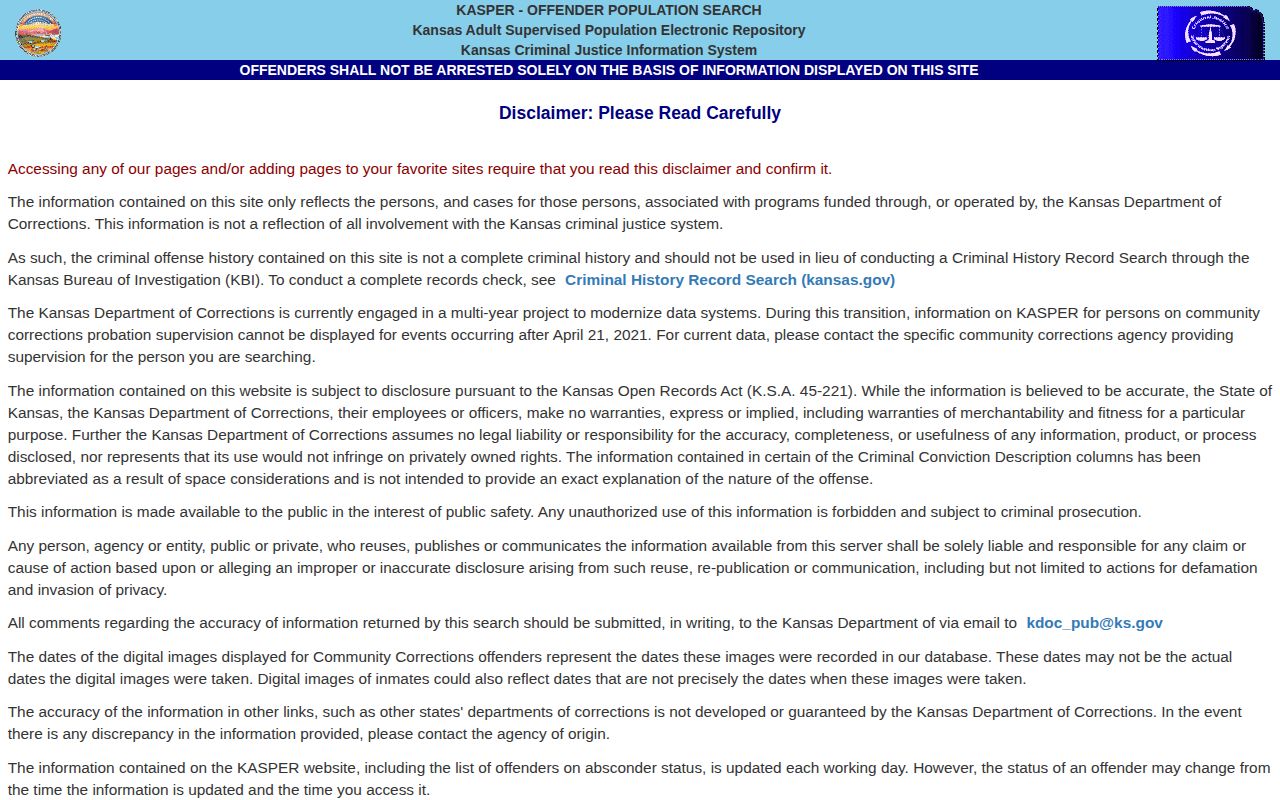
Live labels and results can change. Reopen KASPER to verify the current status, exact date wording, institution or supervision entry, and person identifiers instead of treating a saved image as a current record.
Kansas Corrections After Release
KDOC Parole Services supervises state prisoners released under parole or postrelease authority. It does not replace Washington County court services or community corrections for every probation case. The sentencing journal entry identifies the kind of supervision imposed. KASPER helps confirm state-prison-related supervision, while the court docket is the better start for county probation.
The official parole contacts assign Washington County to the Junction City Parole Office at 446 Grant Avenue, Junction City, Kansas 66441, telephone 785-238-1911. Ask for public confirmation of status and office assignment. Residence, schedules, treatment, safety information, and other protected details may not be public.
KASPER provides separate parole and community-corrections absconder searches. Their lists update on working days. An absconder entry means the responsible office reports loss of contact or noncompliance. It is not a final discharge, proof of a new offense, or assurance that a warrant can be executed without current agency verification.
Request Kansas Corrections Records
KASPER is a public summary, not every underlying KDOC document. When the displayed record does not resolve a movement, sentence, supervision, or discharge question, use KDOC’s records contact and provide the KDOC number. Ask for the existing record and identify the exact field, event, or date at issue. State-record fees, redactions, and delivery rules apply; the Sheriff’s published fee for a local incident report does not transfer to KDOC records.
Kansas open-record rules concern existing agency records. They do not generally require staff to write a new explanation. A response may produce records, cite a lawful closure, redact protected material, or explain when production can occur. Ask for an estimate before costs exceed a stated ceiling. Medical, security, victim, juvenile, sealed, and other protected details may be withheld even when a public status is available.
For a sentence question, also obtain the Washington County District Court journal entry. For the exact handoff from Washington County Jail to KDOC, request the local release or transfer transaction. The Washington County Jail release page identifies that local custodian and its records route. Neither office should be asked to certify an event maintained only by the other.
Kansas Corrections Search Limits
KASPER does not index every Kansas arrest or brief county confinement. It covers people and cases tied to KDOC-operated or funded programs. Community-corrections probation events after April 21, 2021 may be unavailable during system modernization, so the supervising agency may hold the better record. Interstate-compact prisoners sent into Kansas are excluded from the repository scope described by KDOC.
The public information and absconder lists update on working days, while KDOC’s locating information describes daily updates except weekends. A status can change after the last update. Names generally persist after discharge unless a conviction is overturned on appeal, expunged, or executive clemency is granted. That persistence is why KASPER can help after a prison release, but every result still needs identity and date checks.
VINE is not the substitute for this state-prison search. Kansas VINE coverage is limited to offenders housed in participating county jails and expressly excludes KDOC prisoners in state prisons. For someone sentenced from Washington County to KDOC, use KASPER first, then the named state office or institution.