
Washington County Parole and Probation
“Out of jail” does not always mean free of correctional authority. Kansas uses several forms of community supervision, and each has a different source. KDOC Parole Services supervises people released from a Kansas prison on parole or postrelease supervision. Washington County probation starts with a judicial sentence. Court services or community corrections may supervise it, depending on the order. The sentencing journal entry is the best source for the form imposed.
A person can also leave Washington County Jail for another jail, KDOC, federal custody, or immigration custody. That is a transfer, not supervised release to the community. The Sheriff’s release transaction should identify the receiving authority. If KDOC later releases that person, KASPER and the assigned parole office control the state event. Washington County Jail cannot certify a later prison release.
| Form | What it means | Best verification |
|---|---|---|
| Probation | A court permits the person to live in the community under judicial conditions. | Washington County court docket, signed journal entry, and supervising office. |
| Parole | Community release under authority that applies to a parole-eligible sentence. | KASPER, KDOC Parole Services, and Prisoner Review Board records. |
| Postrelease supervision | A statutory supervision term follows prison for many Kansas guidelines sentences. | KASPER status, sentence record, and the assigned KDOC parole office. |
| Final discharge | The relevant correctional sentence or supervision authority has ended. | Discharge certificate, court order, or exact KDOC status and date. |
- Absconder
- A person whom a supervision agency reports as out of contact or noncompliant.
- Detainer
- A request by another authority to hold or receive a person.
- Discharge
- The end of the identified sentence or supervision authority, not merely release from a building.
Verify Washington County Post-Release Supervision
Use the source tied to the sentence. A name-only match can join the wrong person to a case, so compare a KDOC number or court case number and other lawful identifiers. KASPER is useful for people who entered KDOC authority because its records may persist after prison release. It is not a complete index of every Washington County probationer.
- Search KASPER if a Kansas prison sentence may be involved. Confirm the KDOC number, aliases, conviction county, and identifying details.
- Read the exact status, location, supervision, sentence, and date labels together. Do not translate “post release” or “parole” into “discharged.”
- Use the KDOC Parole Services directory to confirm the field office for a KDOC case.
- For probation, search the Kansas District Court Public Access Portal and obtain the signed Washington County journal entry.
- Check later docket events for revocation, extension, warrant, or discharge. Confirm current public status with the responsible office.
The court record tells what the judge ordered. It may show probation, jail credit, revocation, or discharge. KASPER tells what KDOC reports for a person within its system. Neither source should be stretched beyond its scope. For the physical Washington County Jail exit, request the Sheriff’s booking and release record through the site’s released-inmate search and records path.
Keep three timelines separate. The custody timeline records admission, transfer, and physical exit. The case timeline records bond, sentence, probation, revocation, and signed orders. The supervision timeline records office assignment, compliance status, absconder reporting, and discharge. A sound match joins them by a KDOC or case number and dates, not by name alone. A court may order probation before jail processing ends, while KASPER can update after a state supervision change.
Note: A portal no-result may reflect spelling, access limits, record age, or a system outside that portal, not final discharge.
Washington County Parole Office
The official KDOC parole-office contacts assign Washington County to the Junction City Parole Office. This is the office-level route for a person under KDOC parole or postrelease authority. Public confirmation may be limited. Residence, appointment, treatment, and safety details can be confidential, so ask for the person’s public supervision status and responsible office rather than private schedule data.
Junction City Parole Office
446 Grant Avenue
Junction City, KS 66441
785-238-1911
County probation is different. Begin with the Washington County District Court record and the sentencing journal entry. The county’s dedicated court page lists the clerk’s office at P.O. Box 235, Washington, Kansas 66968, telephone 785-325-3265, with weekday public hours from 8 a.m. to noon and 1 to 5 p.m. The county directory separately gives a different number, so call the dedicated District Court page number before travel.
Washington County Absconder Records
KASPER provides separate official searches for parole absconders and community-corrections absconders. The disclaimer says the lists update each working day. Search the correct list, verify identity, and note the access date. A delayed update can matter.
The official KASPER parole-absconder search is the source shown in the captured view.
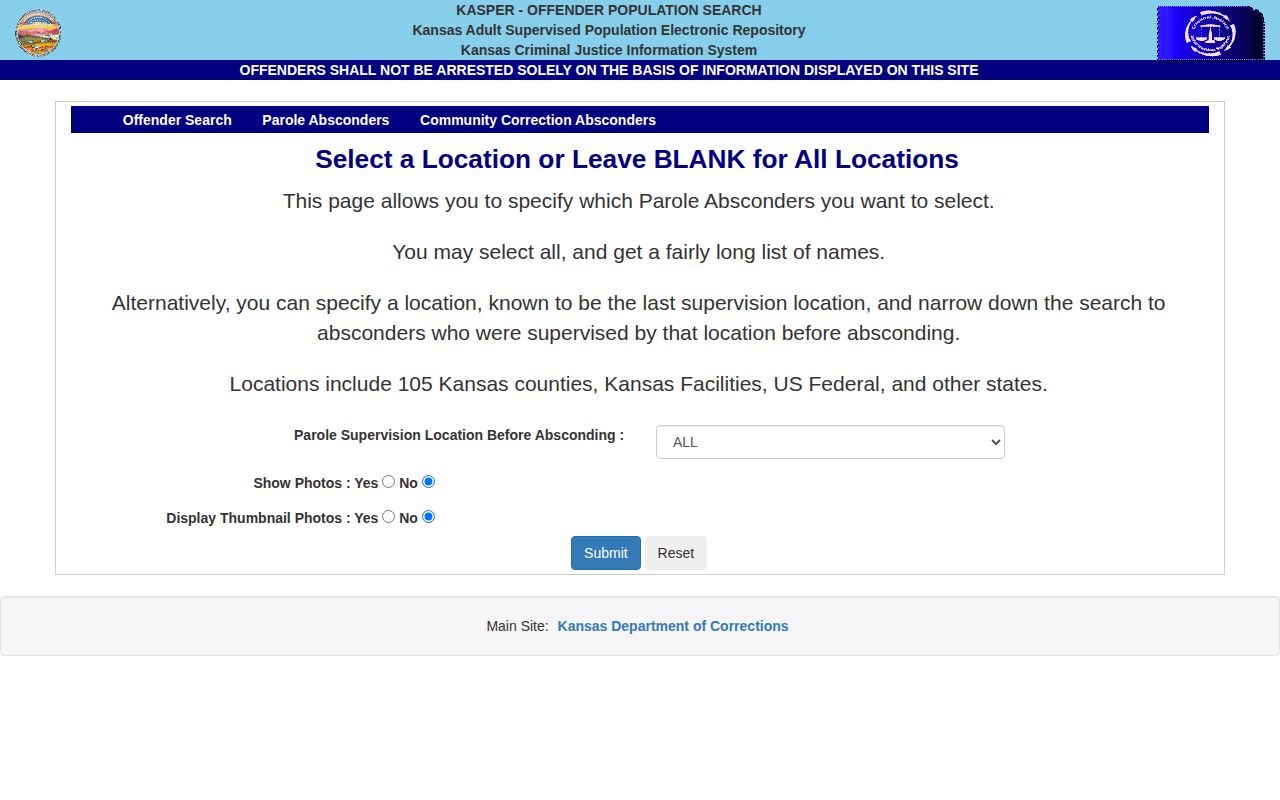
The screen is a search entry point, so any returned name still needs identity and current-status checks.
An absconder label means the responsible agency reports loss of contact or noncompliance. It does not by itself prove a new conviction, a final court ruling, or that a warrant is executable at the instant of the search. Check the Washington County court docket for a filed warrant or revocation event, then seek current operational confirmation from the responsible agency or law enforcement.
Washington County Parole Hearing Records
The Kansas Prisoner Review Board performs the release-decision functions assigned to it by law, but a discretionary parole hearing is not part of every Kansas prison sentence. Old-law indeterminate cases can involve a suitability decision. Many modern guidelines cases instead lead to postrelease supervision, with the board setting conditions or addressing violations rather than selecting the routine prison-release date.
The public-comment sessions list is a rolling schedule, not a decision archive. Its county field is the county of conviction, not necessarily the person’s home or release destination. The official board process distinguishes parole, continue, and pass. “Continue” postpones a decision for more information or deliberation. “Pass” denies release for a stated period. Eligibility is not suitability, and a listed hearing is not a release order.
No official public name-searchable decision-results database was found in the research. Obtain an individual outcome from PRB or KDOC as law allows, then use later KASPER status as downstream evidence. A projected release date and a parole eligibility date are not interchangeable.
Conditions and violation details require restraint. Public records may establish that supervision exists, that a violation was filed, or that an agency reports absconder status. They do not support guesses about private treatment, residence, or reporting schedules. A filed violation is not a final revocation. Read the later court or board action and the current agency status before stating the result.
Washington County Supervision Discharge
Physical release, active supervision, and final discharge may have three separate dates. Kansas law at K.S.A. 22-3722 addresses service while on parole or conditional release and the later discharge certificate. After satisfactory compliance, the board may issue final discharge under the statute’s timing rules. At the end of postrelease supervision, the board issues the discharge certificate.
A Washington County probation discharge instead appears through the court case and supervision records. Review the signed order, not just an abbreviated docket label. One discharged case does not prove that all other cases, warrants, registry duties, or authorities have ended.
VINE does not solve this question. Kansas VINE covers county-jail custody events and expressly excludes KDOC state-prison inmates. A custody alert can help confirm that someone left a covered jail, but it is not a supervision-discharge certificate. Federal supervision is also separate, and BOP’s locator concerns federal custody rather than Kansas parole or county probation.
When offices give different answers, compare the date and scope of each record. A court order may address probation in one Washington County case while KASPER reports parole or postrelease status from another sentence. Ask each custodian which case, sentence, and supervision term its answer covers. Keep the exact status wording. “Inactive,” “closed,” and “discharged” should not be treated as synonyms unless the responsible office confirms that meaning. A later warrant or revocation filing can also change the picture after an earlier check.
Note: Record the agency, case or sentence, exact status wording, date shown, and access date before describing any supervision as complete.