
Washington County Projected Release Dates
A projected date is an estimate produced before the custody event. It can reflect sentence length, jail credit, good-time credit, program credit, consecutive or concurrent terms, and the agency’s current computation. It should always be recorded with an “as of” date. An actual release date documents the event after processing. The two dates answer different questions.
Pretrial custody is different. A person held at Washington County Jail while a case is pending may leave after bond, recognizance, dismissal, a court order, or transfer. Those events depend on the court and any other hold. There may be no sentence-based date to calculate. Ask the jail whether the person remains there, then check the District Court record for the controlling order.
| Date or event | Meaning | Best source |
|---|---|---|
| Anticipated release date | KDOC’s current projected date label; it may change. | KASPER and KDOC Sentence Computation Unit. |
| Parole eligibility | A possible review point in a parole-governed case, not a release order. | Prisoner Review Board and sentence record. |
| County jail release | The completed local custody transaction. | Washington County Sheriff release record. |
| Actual prison release | The completed KDOC physical release event. | KASPER or KDOC records. |
| Final discharge | The identified sentence or supervision authority has ended. | KDOC discharge status/certificate or court order. |
Find Washington County Release Dates
First determine whether the person is in the Washington County Jail, a KDOC institution, another county, or federal custody. A missing local name does not prove release because Washington County publishes no official online jail roster and because transfer can end local custody. Use the agency that owns the current record.
- For Washington County Jail, call 785-325-2293, extension 1. Ask whether the person remains there and whether any recorded departure was community release or transfer.
- Search the Kansas District Court Public Access Portal for bond, commitment, sentence, jail credit, probation, revocation, and warrant entries. Obtain the signed order when a docket label is unclear.
- For a state prisoner, open KASPER. Search by name or KDOC number and verify identity before reading dates.
- Record KASPER’s exact “Anticipated release date” label, current status, sentence information, and access date. Do not rename it “actual release.”
- If computation detail is needed, contact the KDOC Sentence Computation Unit at 785-296-3317 and provide the KDOC number when known.
- After the event, confirm the actual date through the Sheriff or KDOC record. Use the court case to explain the legal authority.
KASPER is for people associated with KDOC authority, not most brief county-jail episodes. It is updated daily except weekends according to KDOC’s locating information. It can include people incarcerated, under post-incarceration supervision, or discharged from a sentence. That persistence makes it valuable after a prison release, but community-corrections probation data can be incomplete. County-only cases belong with the Sheriff and court.
The Washington County released-inmate search gives the full record-request path when a completed jail event is not online.
Washington County KASPER Date Fields
The live KASPER form supports name and KDOC-number criteria plus identity refinements such as aliases, KBI identifier, race, gender, birth date or age, conviction county, and parole-supervision county. Open a result only after comparing the KDOC number, aliases, and other lawful identifiers. A same-name match can attach the wrong sentence to the inquiry.
The captured KASPER search is the official state entry point for a Washington County defendant who entered KDOC custody.
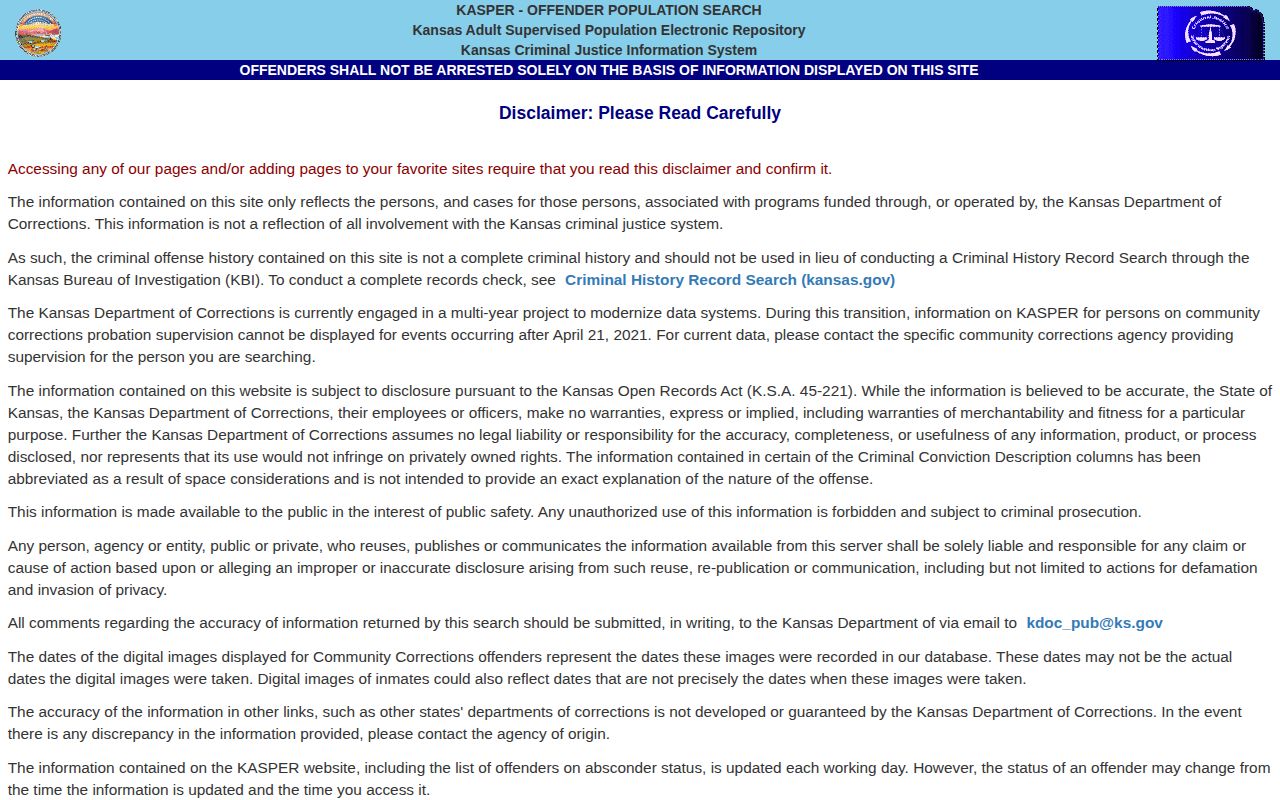
The image identifies the source, while a live person record supplies the date and status labels needed for an actual lookup.
KDOC’s public information can include physical description, photograph, crimes, conviction county, case number, current placement, movement dates, parole office, custody or supervision level, and discipline. Not every field appears on every record. Several sentences may also be listed, so a date can relate to one calculation rather than every legal obligation.
| KASPER item | Release-date use |
|---|---|
| KDOC number | Anchors the correct person and helps KDOC answer a computation question. |
| Status | Distinguishes incarcerated, parole, postrelease, absconder, or discharged wording. |
| Anticipated release date | Shows the current projection, subject to later credit and sentence changes. |
| Movement or placement | Helps distinguish prison custody from supervision or transfer. |
| Sentence and case | Connects the date to the controlling convictions and terms. |
| Parole office | Points to supervision after physical prison release. |
Capture the exact live label and date. If a released record does not display a projected field, use the actual release or status fields it does show. A historical actual date is better evidence of a completed release than an earlier estimate.
Kansas Good Time in Washington County
Kansas sentencing regimes matter. Guidelines sentences often contain both a prison component and a postrelease-supervision component. Older or otherwise parole-eligible sentences can involve Prisoner Review Board authority. A simple percentage cannot resolve both systems, and it cannot replace the journal entry or KDOC calculation.
K.S.A. 21-6821 caps good time deducted from the prison portion at 15 percent for crimes committed on or after July 1, 1993. The cap is 20 percent for qualifying nondrug severity levels 7 through 10 committed on or after January 1, 2008, and for specified lower-severity drug groups based on offense date. Thus “serve 85 percent” is shorthand only for the 15-percent-cap group. Some eligible sentences can approach 80 percent before other factors are applied.
The same statute allows eligible prisoners up to 120 days of program credit for successful completion of specified education, vocational, substance-use, or other risk-reduction programs. Eligibility, forfeiture, and restoration rules still control. For qualifying sexual or sexually motivated offenses, credit deducted from prison can be added to postrelease supervision. It should not be described as a cut in the total span of state authority.
Do not multiply a pronounced term by .85 for a named person. Jail credit, sentence aggregation, consecutive or concurrent structure, exclusions, court corrections, other cases, and KDOC computation all matter. Postrelease supervision begins after prison release and is not subtracted as “time served.”
Old-Law Washington County Release Dates
For crimes before July 1993, K.S.A. 22-3725 provides an old-law good-time table and expressly does not govern later crimes. The modern 15- or 20-percent cap should not be applied backward to an old indeterminate sentence.
The Prisoner Review Board process distinguishes indeterminate parole eligibility and conditional release from determinate postrelease. The board can return parole, continue, or pass in cases within its authority. A scheduled hearing, public-comment session, or eligibility date is not a release grant. “Continue” means more time or information is needed. “Pass” is a denial for a stated period.
- Determinate sentence
- A fixed term calculated under the applicable sentencing rules, often followed by postrelease supervision.
- Indeterminate sentence
- An older sentence structure in which parole eligibility and board authority can affect release.
- Good time
- Credit governed by statute and agency rules that may reduce the prison portion.
- Program credit
- Credit for qualifying completed programs, subject to eligibility and forfeiture rules.
Note: Offense date, sentencing law, journal entry, and the responsible agency’s calculation must all match before a date is characterized.
Washington County Jail Date Rules
Do not import KDOC prison good-time assumptions into a Washington County Jail sentence. The county site publishes no local jail earned-credit formula, weekend-release rule, or calculation policy. Ask the Sheriff whether a written local good-time policy applies to the specific sentence. Obtain the court commitment or journal entry and the jail-credit calculation.
The Sheriff’s release transaction should tie the person to a booking number, admission episode, actual release date and time, transaction type, authority, and destination to the extent those fields exist and are public. The District Court record can show sentence, probation, time credit, dismissal, or bond. It may not show the minute when jail processing ended. Pair the two records.
The official reports page permits in-person or written requests for offense or incident reports and publishes a fee for that distinct product. It does not publish a release-record fee or a special release-date form. Ask the records custodian for available fields, lawful cost, and an estimate. Under KORA, request an existing record rather than requiring the agency to create a new calculation or narrative.
Why Washington County Dates Change
A projected release date can move in either direction. The cause should be traced to an agency record or court order, not inferred from a changed public screen.
| Factor | Possible effect |
|---|---|
| Good-time loss or restoration | Discipline or later restoration can change earned credit. |
| Program credit | Qualifying completion may affect the prison calculation within statutory limits. |
| Jail-credit correction | An amended credit amount changes time remaining. |
| New or amended sentence | Court action can change the controlling term or sentence order. |
| Consecutive cases | One term may begin after another rather than at the same time. |
| Detainer or transfer | One custody term can end while another authority takes the person. |
| Parole action | Board authority can affect an eligible old-law case. |
A VINE alert can provide notice of a county-jail event, but Kansas VINE excludes KDOC inmates. For a Washington County Jail notification, use the VINE inmate check and then verify the event with the jail. For KDOC, recheck KASPER and the responsible state office. Federal projected dates belong to BOP, while ICE custody uses a separate civil locator and has no verified local facility in Washington County.
Recheck the source after any new court order or custody move.
Note: Always keep the date label, source agency, relevant case or offender number, and access date with the projected figure.